+86-17692703999
+86-17692703999 No. 6, West Side Auxiliary Road,
Sunshine Street, Linxi County, Xingtai
City, Hebei Province
Sunshine Street, Linxi County, Xingtai
City, Hebei Province

Views: 0 Author: Site Editor Publish Time: 2026-10-08 Origin: Site

Operating heavy machinery in abrasive ground conditions presents a severe operational challenge. Materials like granite, slag, and high-silica sand act as massive grinding wheels. They accelerate the wear of ground engaging tools at an alarming rate. Choosing the wrong teeth leads directly to premature breakage and sluggish digging cycles. It also increases fuel consumption due to poor penetration and causes excessive machine downtime. You simply cannot afford to guess when outfitting your fleet for these harsh environments.
This guide provides an evidence-based framework for evaluating wear materials, profiles, and retention systems. You will learn how to balance surface hardness with core toughness. We will detail the specific metallurgical properties required to survive extreme sliding friction. Ultimately, this article aims to help you maximize your return on investment in high-abrasion applications by shifting your procurement strategy from unit cost to hourly performance.
Abrasive ground conditions establish a brutal operational baseline. Highly abrasive materials constantly rub against the steel components of your machinery. They strip away standard bucket teeth in a mere fraction of their intended lifespan. When you install inferior or mismatched components, you initiate a cascade of hidden costs.
Suboptimal ground engaging tools do more than just wear out quickly. They introduce severe mechanical and financial burdens across your entire operation. You must account for these secondary impacts.
You must shift your procurement mindset immediately. Stop searching for the cheapest replacement part. Start prioritizing the longest predictable wear cycle. Predictability allows maintenance teams to schedule replacements during planned downtime. This proactive approach eliminates catastrophic mid-shift failures. Your success metric becomes the lowest operational cost per hour achieved.
Mastering excavator bucket teeth selection requires a deep understanding of material science. You cannot evaluate a tooth based on appearance alone. The underlying metallurgical properties dictate how the part behaves underground.
Heavy equipment operators face a perpetual dilemma. Extremely hard teeth resist sliding abrasion brilliantly. However, they become brittle and can shatter instantly upon heavy rock impact. Conversely, highly tough and flexible teeth absorb impacts easily. Yet, they wear down far too quickly in highly abrasive soil.
You must look for differentially heat-treated components. Premium manufacturers harden the exterior shell to combat sliding abrasion. Simultaneously, they maintain a ductile, softer core. This inner core absorbs shock waves from impact, preventing catastrophic fractures.
Alloy steel compositions separate premium parts from budget alternatives. The precise blend of elements dictates the final physical properties of the steel.
Always ask suppliers for objective testing data. Request Brinell Hardness Number (BHN) ratings for the exterior shell. Demand impact test results, such as the Charpy V-notch score, to verify internal toughness claims.
How the manufacturer shapes the steel matters immensely. High-quality investment casting pours molten steel into complex molds. This process allows engineers to place bulk wear material exactly where needed. It accommodates intricate shapes and specialized profiles. Forging stamps solid steel blocks under immense pressure. Forged parts offer superior grain structure and exceptional strength. However, forging severely limits the physical shape of the final product. For heavy abrasion, investment casting generally provides the optimal balance of shape customization and durability.
| Property | Ideal Range | Primary Function |
|---|---|---|
| Brinell Hardness (Surface) | 450 - 530 BHN | Resists severe sliding abrasion and gouging. |
| Impact Toughness (Charpy) | > 20 Joules at -20°C | Absorbs heavy shock loads without shattering. |
| Alloy Composition | High Chromium / Boron mix | Ensures deep hardening and structural integrity. |
The physical geometry of the tooth determines how it enters the soil and how long it survives. Selecting an inappropriate profile guarantees premature failure, regardless of the steel quality.
Manufacturers design distinct profiles for specific digging environments. You must match the profile exactly to your site conditions.
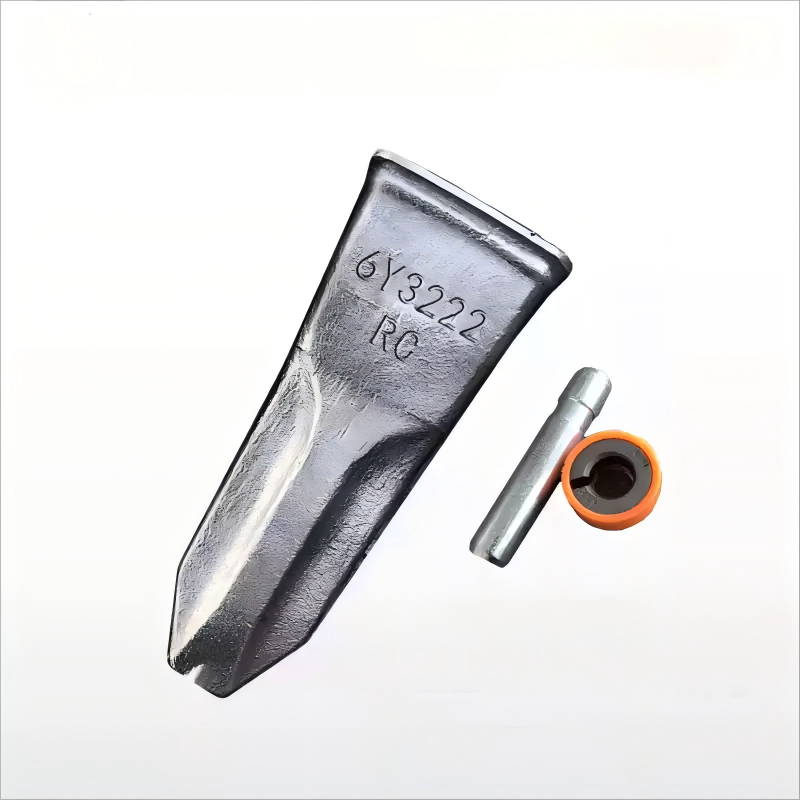
Let us examine a real-world benchmark. The CAT 6Y3222 bucket tooth serves as an excellent example of a heavy-duty, abrasion-style profile. Engineered for the popular J300 series, it incorporates substantial extra mass on the bottom wear surface.
This added bulk performs a critical function. It absorbs the primary brunt of the friction as the bucket curls through abrasive material. By taking the wear on its thickened bottom, this profile actively protects the adapter strap beneath it. Protecting the adapter extends the overall life of the entire bucket assembly. This design logic proves essential in high-silica environments.
Modern engineering offers another structural advantage: self-sharpening profiles. As abrasive material flows over the top and bottom of the tooth, it wears the steel away unevenly. Engineers design specific ribs and cavities into the casting. These features ensure the leading edge remains sharp even as the total mass decreases. Maintaining a sharp edge preserves penetration efficiency over the entire lifespan of the component. This keeps your fuel burn consistent from day one until the replacement day.
A premium tooth becomes worthless if it does not remain securely attached to the machine. You must evaluate the entire assembly, including adapters, pins, and retainers.
Ensure your selected components perfectly match the existing shank or adapter welded to your bucket. Popular standardized systems include the Caterpillar J-Series, Komatsu, and Esco styles. Even a millimeter of mismatch causes severe problems. Loose fitment leads to internal rattling during operation. This rattling shears pins and accelerates internal wear on the adapter nose. Eventually, the adapter rounds off entirely, requiring a costly cut-and-weld repair.
Standard side-pin systems utilize a simple metal pin and a rubber lock. In high-vibration, high-abrasion environments, these conventional locks often fail. Abrasive fines pack into the pinhole, compressing the rubber. The pins can then easily walk out during operation. Losing a tooth into a rock crusher causes catastrophic downstream damage.
You should strongly evaluate alternative retention methods. Drive-through pins offer higher security in abrasive wash. Hammerless systems provide the ultimate solution. They utilize a mechanical locking mechanism requiring only a simple socket wrench. Hammerless systems ensure safer, faster replacements in the field while eliminating the risk of pins vibrating loose.
The teeth only protect the leading edge. The adapters face intense abrasive wash as material flows into the bucket. Inspect your chosen bucket setup carefully. Determine if it allows for the installation of wear caps. Mechanics can weld or pin these caps directly onto the top of the adapters. Wear caps absorb the sliding friction, protecting the expensive adapter underneath. Replacing a wear cap takes minutes and costs a fraction of an adapter replacement.
Procurement departments often make the mistake of buying based on the initial invoice price. This strategy virtually guarantees higher operational expenses over the course of a year. You must evaluate components based on their true economic return.
To determine the actual value of your wear parts, you must track their performance in the dirt. Use a simple framework to calculate the operating cost:
Formula: (Initial Cost + Installation Labor + Downtime Cost) / Operating Hours Achieved
If a budget tooth costs half as much but lasts one-third as long, it ultimately costs you more per hour. Factor in the labor hours required for the extra changeouts. Include the revenue lost while the excavator sat idle. The hourly metric reveals the undeniable value of premium, heavy-duty parts.
Do not accept marketing claims at face value. Demand transparency from your manufacturing partners.
Transitioning your fleet requires a systematic approach. We advise running a practical "pilot bucket" test before committing fully. Paint one side of a test bucket green and install the new heavy-duty parts. Paint the other side red and install your legacy components. Put the machine back to work in your most abrasive sector.
Measure the real-world wear rates side-by-side every fifty hours. This visual and measurable proof removes all guesswork. Once you confirm the improved hourly rate, you can confidently scale the excavator bucket teeth selection across your entire fleet.
Conquering abrasive ground remains a matter of strategic metallurgical and profile selection. It goes far beyond simply replacing broken parts with the cheapest available metal. You must balance impact toughness with extreme surface hardness. You must choose profiles designed specifically to absorb sliding friction while protecting your adapters.
Reiterate the importance of tracking the hourly performance of components like the CAT 6Y3222. Evaluating your wear parts through the lens of operational cost-per-hour will systematically lower your overall expenses. It keeps your machines digging rather than sitting in the maintenance bay.
Take action immediately. Audit your current bucket tooth wear patterns this week. Identify signs of premature wear or adapter damage. Contact your current suppliers and request detailed material specification sheets to ensure you are getting the quality your site demands.
A: The replacement interval depends entirely on the silica content of the ground and your daily operating hours. You should rely on visual inspection rather than a calendar. Replace the tooth when it loses its defined penetration profile or wears down enough to expose the adapter to abrasive wash.
A: Yes, but it is not optimal. Rock teeth prioritize aggressive penetration and impact resistance for prying boulders. Heavy-duty abrasion teeth contain significantly more wearable mass designed specifically to endure continuous sliding friction without washing away prematurely.
A: Cast teeth are poured into molds as molten steel, allowing for complex wear profiles and thicker mass where needed. Forged teeth are stamped from solid steel blocks, offering superior structural integrity but limited shape variations. Both perform exceptionally well if heat-treated correctly for the application.
A: Identify the adapter size and pin style currently installed. Manufacturers use standardized series numbers, such as the J-Series. Check the specific part number cast directly into your current teeth or adapter to ensure a precise dimensional match.