+86-17692703999
+86-17692703999 No. 6, West Side Auxiliary Road,
Sunshine Street, Linxi County, Xingtai
City, Hebei Province
Sunshine Street, Linxi County, Xingtai
City, Hebei Province

Views: 0 Author: Site Editor Publish Time: 2026-08-12 Origin: Site

Premature wear in pivot joints leads to catastrophic equipment failure. Unplanned downtime destroys project budgets rapidly. You must select the right materials for these heavy-duty components. This choice is deeply financial, rather than just an engineering exercise. Equipment managers constantly balance wear resistance against impact resistance. They must also factor in actual field lubrication habits. Poor choices guarantee early breakdowns. This guide provides an evidence-based breakdown of primary pivot materials. You will learn how to match alloys to specific load environments. We also reveal crucial specifications to verify before purchasing your next pin and bushing set. By understanding these metallurgical differences, you can eliminate recurring maintenance nightmares.
Incorrect material choices create severe financial liabilities. Heavy equipment requires precise component matching to survive harsh operating conditions. When you install mismatched pivot materials, you guarantee premature mechanical failure. These failures trigger cascading expenses. You will pay for frequent replacement labor. You will endure expensive line-boring costs to repair damaged structural housings. Most importantly, you suffer massive financial losses from stalled production lines.
Every mechanical joint experiences specific stressors. When materials cannot handle these forces, components break down quickly. You should watch out for these three common failure modes:
You must follow the golden rule of mechanical pairs. Engineers always specify the pin to be significantly harder than the bushing. The bushing acts as the sacrificial wear part. It absorbs the bulk of the friction. Replacing a worn bushing is fast and affordable. Replacing a damaged pin or a structural boom is highly expensive.
Heavy machinery operates in extreme environments. Excavator buckets, loader arms, and backhoe pivots experience massive shock loads. These high-load zones demand exceptional tensile strength. Alloy steels provide the necessary durability to survive these brutal conditions. They remain the undisputed foundation of heavy industry.
When selecting a construction machinery pin and bushing set, you will typically encounter two distinct categories of steel. Your choice depends heavily on your budget and expected machine lifespan.
Medium carbon steels serve as a cost-effective baseline. Material grades like 1045 offer decent machinability and moderate strength. They perform well in light to medium-duty applications. However, they require strict maintenance protocols. You must guarantee frequent and consistent greasing. If lubrication fails, 1045 steel wears down rapidly. It lacks the advanced alloying elements required to resist aggressive abrasion.
Chromium-molybdenum alloys represent the industry standard for severe applications. Grades like 4140 and 4340 dominate the heavy equipment sector. The addition of chromium drastically improves wear resistance. Molybdenum enhances the metal's overall toughness. Together, they create an ideal balance. These alloys withstand massive impacts without fracturing. They also resist the grinding abrasion of dirt and sand.
Raw steel is rarely sufficient for pivot joints. Manufacturers must alter the steel's molecular structure through heat treatment. Proper heat treatment determines component longevity.
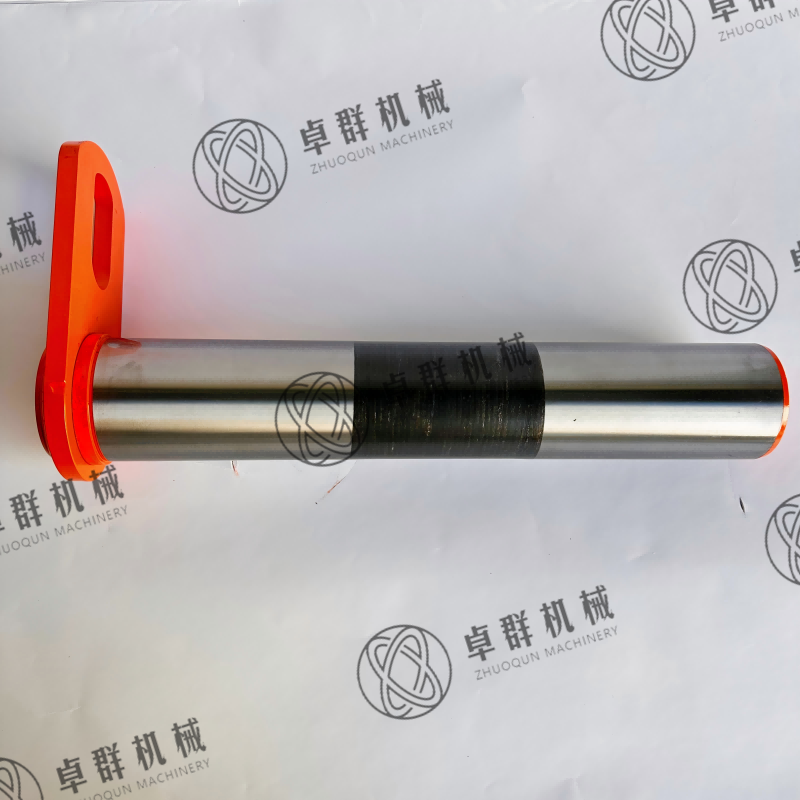
Induction Hardening: This process rapidly heats the exterior of the pin. It creates a deeply hardened outer wear-layer. Crucially, the inner core remains relatively soft and ductile. This ductile core absorbs sudden shock loads. If the entire pin were hardened perfectly through, it would become brittle and snap upon impact.
Carburizing (Case Hardening): This method introduces extra carbon into the surface of lower-carbon steels. It produces an extremely hard, glass-like exterior. It is ideal for highly abrasive environments. However, the hardened case must be thick enough to resist crushing under heavy point loads.
Steel is not always the best answer. Many mechanical zones experience constant friction but minimal impact. Other areas face severe corrosive elements. Sometimes, regular greasing is practically impossible. In these scenarios, bronze and brass alloys provide superior performance. They naturally reduce friction and resist rust.
We see bronze widely utilized in landing gear, industrial presses, and marine environments. Different bronze alloys serve very different mechanical purposes. You must match the specific copper alloy to your operational reality.
Aluminum bronze delivers exceptional structural strength. It handles heavy loads and resists impacts far better than standard brass. Engineers frequently pair aluminum bronze bushings with hardened steel pins. This specific combination actively prevents galling. The bronze provides a slick, durable surface. It survives incredibly well in saltwater and corrosive industrial settings.
Manganese bronze thrives under extremely high loads. It performs optimally in low-speed, high-pressure environments. However, you must monitor it carefully. This material demands highly reliable lubrication. Without a steady supply of grease, manganese bronze will overheat and degrade. It is incredibly strong but less forgiving of maintenance neglect.
Sintered bronze offers a brilliant engineering solution for inaccessible joints. Manufacturers create it by pressing bronze powder into a porous solid. They then vacuum-impregnate these pores with lubricating oil. During operation, the friction generates heat. This heat draws the oil to the surface, creating self-lubrication. When the machine stops, the bronze reabsorbs the oil. It is strictly suited for lighter loads and continuous motion.
Review the comparison summary below to understand bronze material applications.
| Material Type | Primary Strength | Load Capacity | Lubrication Requirement |
|---|---|---|---|
| Aluminum Bronze | Anti-galling, corrosion resistance | High | Moderate |
| Manganese Bronze | Raw load-bearing power | Very High | Strictly High |
| Sintered Bronze | Self-lubricating properties | Low to Medium | None to Minimal |
Modern engineering frequently replaces traditional metals with advanced synthetic materials. Automotive suspensions, agricultural machinery, and processing plants rely heavily on these compounds. They excel in environments plague by severe vibration, aggressive dust, or chemical exposure.
You must understand the distinct behavior of different elastomeric compounds. Choosing the wrong polymer degrades ride quality and accelerates component failure.
Polyurethane acts as a massive upgrade over standard rubber. It offers a substantially higher load-bearing capacity. It resists cutting, tearing, and aggressive abrasion. Furthermore, polyurethane ignores common chemical threats. It resists degradation from engine oils, hydraulic fluids, and atmospheric ozone. Mechanics frequently use it to stiffen suspension components. It limits unwanted deflection and improves handling precision.
Traditional rubber remains highly relevant for specific reasons. It provides unmatched NVH (Noise, Vibration, and Harshness) dampening. Rubber isolates the operator chassis from mechanical vibrations beautifully. It is also far more forgiving in slightly misaligned joints. However, it carries distinct disadvantages. Rubber degrades rapidly under UV exposure. It swells and rots when exposed to petroleum-based fluids.
PTFE composites represent the peak of zero-maintenance technology. These bushings utilize a steel or fiberglass backing lined with a woven Teflon matrix. They deliver exceptional self-lubricating properties. You typically install them in hard-to-reach pivot points. They ignore dust, dirt, and lack of grease. However, you cannot use them for massive impact loads. Heavy shock easily crushes the thin PTFE liner.
Selecting the right base material is only the first step. You must strictly evaluate the manufacturing specifications. Poor machining ruins excellent steel. You must demand documented engineering data from your vendors.
Always review your pin and bushing set specifications against the following four criteria. Ignoring these details guarantees early failure.
Hardness dictates wear rates. Engineers measure this using the Rockwell Hardness Scale (HRC). As established earlier, the pin must be harder than the bushing. You should look for a specific differential spread. Typically, an ideal pairing features a pin heat-treated to 55-60 HRC. The corresponding bushing should measure between 45-50 HRC. This 10-point spread ensures the bushing takes the wear predictably. It protects the expensive pin from dimensional loss.
Tolerances control how precisely the parts fit together. If the clearance is too loose, abrasive contaminants enter the joint easily. The joint will slap and hammer itself to pieces. If the clearance is too tight, the grease cannot form an adequate hydrodynamic film. The metals will rub dry and gall. Precision CNC machining creates the exact micro-clearance required to retain grease while blocking dirt.
Surface roughness is measured in Ra (Roughness Average). A visually shiny pin is not necessarily smooth on a microscopic level. If the pin features rough machining marks, it acts like a metal file. It will shred the softer bushing in weeks. You must demand a micro-polished surface finish on all load-bearing pins. A polished pin drastically extends the life of any mating bushing.
Grease cannot magically distribute itself under extreme pressure. Bushings require engineered grease grooves to channel lubricant across the wear zone. You must evaluate the grooving pattern based on the joint's movement.
The heavy parts market contains many counterfeit and low-quality components. You cannot rely on visual inspections to determine steel quality. Sourcing requires strict vendor qualification. When you need parts tailored to unusual failure modes, you must find a true manufacturing partner.
Use the following numbered criteria to evaluate any potential vendor before placing a bulk order.
Selecting the correct pivot components directly impacts your operational profitability. You must move past generic labels like "hardened steel" and understand the metallurgy at play. Application always dictates the material choice.
You should default to heat-treated alloy steels like 4140 for extreme impact zones. You must utilize bronze alloys for high-load friction applications where lubrication is inconsistent. Finally, you should leverage modern polymers for environments plagued by severe vibration or extreme dust. Always enforce the 10-point HRC differential rule to protect your pins.
Before you request your next quote, take immediate action. Document your current maintenance intervals meticulously. Photograph your specific failure types to identify galling or spalling accurately. Present this data to a verified manufacturer. Demand clear chemical certifications and strict dimensional tolerances. By controlling these variables, you will drastically extend your equipment lifecycle and eliminate unplanned downtime.
A: Rarely. Using identical materials with the exact same hardness drastically increases the risk of galling. Under heavy friction, identical metals will cold-weld together, causing a catastrophic joint seizure. Always ensure the pin is significantly harder than the bushing.
A: Heat treatment alters the molecular structure of the steel. Processes like induction hardening create an extremely wear-resistant exterior shell. Crucially, it leaves the interior core flexible and ductile. This allows the pin to handle massive shock loads without snapping.
A: No. While polyurethane is excellent for automotive suspensions or light agricultural equipment, it fails under heavy industrial loads. It simply lacks the sheer compressive yield strength required for heavy construction machinery pivots, like excavator buckets or loader arms.