+86-17692703999
+86-17692703999 No. 6, West Side Auxiliary Road,
Sunshine Street, Linxi County, Xingtai
City, Hebei Province
Sunshine Street, Linxi County, Xingtai
City, Hebei Province

Views: 0 Author: Site Editor Publish Time: 2026-11-12 Origin: Site

Imagine being mid-trench on a tight deadline. Suddenly, a dreaded metal-on-metal screech echoes from your bucket linkage. Equipment owners and heavy machinery mechanics face this frustrating reality far too often on the job site. Unplanned downtime kills profitability. Highly expensive undercarriage or arm repairs usually stem from a single, preventable issue. That issue is premature pin and bushing failure.
The mechanical joint connecting the steel pin to the excavator bushing serves as the primary pivot point of your machine's productivity. A common and destructive error during routine replacement or line-boring machining is establishing an incorrect clearance. Clearance is the tiny, intentional gap between the pin's outer surface and the inner wall of the housing.
Finding the perfect specification requires a delicate engineering balancing act. Is the tolerance too tight? The joint starves for grease, overheats rapidly, and eventually seizes solid. Is the tolerance too loose? The machine suffers from sloppy bucket controls, poor grading accuracy, and accelerated component wear. This guide explores standard specifications, practical measurement techniques, and the operational dangers of incorrect tolerances. We will also cover how to select specialized components tailored to your specific job site application.
Clearance is Crucial for Survival: The ideal running clearance typically ranges from 0.10mm to 0.30mm. This specific range depends heavily on the pin's outer diameter and the thermal conditions of the operating environment.
Lubrication Requires Physical Space: A correct specification allows just enough room for a hydrodynamic micro-film of grease to form. Without this precise gap, grease cannot distribute, leading directly to destructive friction.
Precision Measurement Matters: Utilizing the correct metrology tools is an absolute requirement before ordering replacement parts or machining housings. You must use outside micrometers for pins and dial bore gauges for internal diameters.
Application Dictates Material Selection: High-stress and chemically abrasive environments demand specialized metallurgy. Operations in wet conditions benefit from corrosion-resistant parts. Demolition work necessitates high-strength alloys to prevent structural fracturing.
Proactive Replacement Minimizes Long-Term Costs: Spotting wear patterns early prevents catastrophic damage to the boom, stick, and bucket linkages. Addressing a worn pivot promptly can save thousands of dollars in line-boring repairs.
To maintain structural integrity, technicians must understand the engineering principles behind joint clearances. The connection securing the bucket to the stick takes immense shear forces. Dynamic loads spike every time the teeth bite into the soil.
In mechanical engineering terms, clearance is the intentional dimensional difference between the inner diameter of the housing and the outer diameter of the mating pin. Mechanics specifically refer to this as running clearance. You must distinguish this from the press fit. Press fit dictates how tightly the outer shell sits inside the machine's steel housing. The shell must remain stationary within the housing. Meanwhile, the pin requires a calculated running clearance to articulate smoothly under heavy loads.
A common misconception among novice mechanics is targeting zero movement. A perfectly tight fit might feel secure during a shop installation. However, targeting zero clearance is a critical engineering error. Continuous friction generates significant heat on a hot summer day. The solid steel pin and the constrained cylindrical shell expand at different rates. Consequently, a zero-clearance joint will experience thermal lock. The pin will seize completely. Heavy machinery joints rely on grease to separate the steel surfaces. This semi-solid lubricant requires a physical void to occupy. Proper clearance creates an annular space allowing grease to travel from the zerk fitting across the entire load-bearing surface area.
Looking at broader industry shifts, the heavy machinery sector is rapidly moving toward predictive maintenance models. Fleet managers no longer rely solely on reactive repairs. Modern operations increasingly utilize telematics and advanced wear-modeling software to monitor equipment health. Instead of waiting for audible clanking, operators use data analytics to predict exactly when running clearances will exceed optimal thresholds.
This data-driven approach is pushing aftermarket manufacturers to produce tighter, highly application-specific tolerances. The industry is moving away from broad, one-size-fits-all guidelines. Consequently, high-quality aftermarket manufacturers now offer optimized initial tolerances. These modern components anticipate the exact operational stresses of specific job sites, ensuring longer service intervals and reduced unexpected downtime.
Determining the correct specification is never a guessing game. It relies on established mechanical engineering tolerances. The required gap scales proportionally with the diameter of the pin. Smaller mini-excavators require tighter tolerances to maintain precision. Massive earthmovers need more room for thermal expansion and heavy grease distribution.
Always verify exact specifications against your specific machine's service manual. However, industry-standard running clearances for earthmoving equipment generally follow a predictable curve. Below is a core comparison table to guide your baseline assessments.
Pin Diameter Range | Recommended Running Clearance | Typical Application | Primary Risk of Deviation |
|---|---|---|---|
30mm - 50mm | 0.10mm - 0.15mm | Mini-excavator buckets | Loss of fine grading precision |
55mm - 80mm | 0.15mm - 0.20mm | Mid-size excavator sticks | Accelerated dust seal failure |
85mm - 110mm | 0.20mm - 0.25mm | 20 to 30-ton class booms | Severe galling and overheating |
115mm - 150mm+ | 0.25mm - 0.35mm | Heavy-duty quarry excavators | Catastrophic pin seizure |
Deviating from the specified range sets off a chain reaction of mechanical failures. Pivot joints act as the fulcrum for the machine's breakout force. Any inefficiency here translates directly to lost productivity and accelerated component destruction.
Specifying parts with insufficient room restricts the flow of grease. When the joint starves for lubrication, the protective fluid film collapses. The immediate symptoms include galling. Galling is a destructive process where the microscopic peaks of the steel pin and inner wall cold-weld together and violently tear apart under pressure. Operators will notice severe joint overheating. The grease zerk will stubbornly refuse to accept lubrication. Ultimately, a tight specification can cause the pin to lock up completely. The rotational force of the hydraulic cylinders will then force the seized pin to spin inside the unbushed mounting bosses. This ruins the structural housing and requires thousands of dollars in mobile line-boring to repair.
Conversely, excessive clearance proves equally destructive. Operators will quickly notice slop or rattling in the linkage. Fine grading a slope becomes an exercise in frustration. The bucket shifts unpredictably, slowing down cycle times. Mechanically, a loose joint amplifies impact forces. Every time the bucket strikes hard ground, the excessive gap allows the heavy steel pin to hammer violently against the wall. This accelerates oval wear. In addition, loose joints compromise the integrity of the dust seals. When seals fail, silica sand and water enter the friction zone to create a highly abrasive grinding paste.
Relying on visual inspections or the traditional wiggle test is insufficient. You cannot determine whether a component meets engineering specifications by eye. Accurate measurement is the absolute foundation of proper undercarriage maintenance.
To evaluate clearances correctly, mechanics need industrial-grade precision tools. These tools must be capable of measuring to one-hundredth of a millimeter. You will need an outside micrometer exclusively for measuring the pin. You also need a dial bore gauge for measuring the internal diameter of the housing. Standard shop calipers are simply not accurate enough for this critical task.
Follow this systematic measurement process:
Safety and Preparation: Safely lower the bucket to the ground. Turn off the engine and relieve all hydraulic pressure. Lock out and tag out the machine before placing your hands near pinch points.
Component Cleaning: Accurate measurements are impossible if the parts are covered in grit. Thoroughly clean the pin and the inside of the bore using a heavy-duty degreaser. Wiping away abrasive slurry ensures the micrometer anvil sits flush against bare metal.
Pin Measurement: Using the outside micrometer, measure the pin's diameter at the center and at the ends. Take cross-measurements at the twelve and six o'clock positions, then at three and nine o'clock. This identifies if the pin has worn unevenly or developed a taper. Record the smallest diameter found in the wear zone.
Bore Measurement: Insert the dial bore gauge into the bore. Measure at multiple depths and angles. The continuous unidirectional force of digging usually causes parts to wear into an egg shape. Checking for ovality is critical. Record the largest internal diameter measurement.
Calculating Current Clearance: Subtract the smallest pin diameter from the largest internal diameter. Compare this final mathematical figure against the maximum allowable wear limit to determine if replacement is necessary.
When measurements indicate it is time to replace your linkage components, you have an excellent opportunity. You can upgrade the metallurgy to better suit your operational environment. Standard steel alloys work well for general-purpose earthmoving. However, severe applications demand specialized materials.
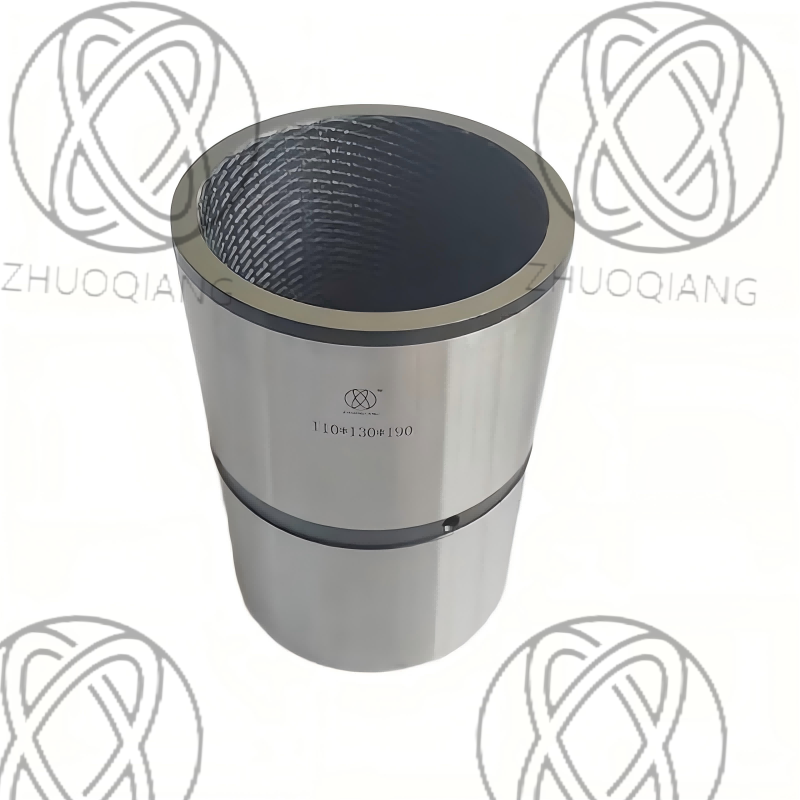
Machines operating in demolition sites, concrete recycling facilities, or rock quarries face extreme shock loads. Standard components are prone to cracking under these conditions. In these scenarios, upgrading to an impact resistant excavator bushing provides a distinct operational advantage. For instance, a 110-130-190 mm configuration forged from high-tensile steel alloys undergoes highly controlled induction heat treatments. This creates a hardened outer wear surface for abrasion resistance. It simultaneously maintains a tough, ductile core that absorbs massive kinetic impacts without shattering.
Excavators deployed in marshlands, coastal dredging operations, or highly acidic soils face a different enemy. Chemical degradation destroys standard carbon steel rapidly through oxidation. Rust compromises structural integrity and physically expands. This expansion alters the clearance gap and increases friction. Utilizing a corrosion-resistant heavy-duty bushing combats this issue. Take an 80x95x80 mm profile featuring specialized zinc-nickel plating or resilient aluminum-bronze alloys. These materials prevent environmental degradation and maintain precise clearances despite constant moisture ingress.
Furthermore, the mining sector represents the ultimate test for heavy machinery. Massive front-shovel machines weighing hundreds of tons operate continuously. The clearance specifications for mining equipment bushings are meticulously engineered. Components designed for 24-ton class machines like the Hitachi 240 series require exact tolerances. The thermal dynamics and load scales are vastly different from standard construction equipment. They feature complex, multi-directional internal grease grooving designed to handle automated, high-pressure auto-lube systems. This ensures the hydrodynamic grease film remains stable under extreme, continuous loads.
The most precise specification in the world is completely useless without proper lubrication. Internal grease grooves machined into the metal specifically distribute lubrication evenly across the entire friction zone.
The engineering specification must mathematically match the viscosity of the grease being used. This ensures the grease can flow freely through the microscopic gap. It creates a fluid barrier that keeps the steel surfaces separated. Freezing temperatures require a lighter grease to flow through the gap. In contrast, summer heat demands a thicker grease to prevent the fluid film from breaking down under heavy pressure.
Maintaining the perfect specification requires operational discipline. A strict daily greasing schedule is mandatory for equipment survival. Pumping fresh grease into the joint lubricates the moving metal. It also actively flushes out abrasive contaminants and moisture that may have bypassed the outer dust seals during a hard day's work.
Operators should monitor their machines closely every single day. Key visual and operational indicators of excessive wear include visible gaps between the pin and the housing. You might notice grease leaking excessively past the dust seals. Distinct clunking or popping sounds during operation are major red flags. Uneven or jerky bucket movement when performing precision grading also signals trouble.
If the measured clearance exceeds the allowable wear limit, immediate replacement is necessary. This limit is often around 1.0mm to 1.5mm depending on the exact machine size. Swapping worn pins and shells early is a relatively low-cost, straightforward maintenance task. However, ignoring the wear causes the housing itself to become oval-shaped. The machine will then require costly, time-consuming line-boring services.
Getting your joint clearance right is vital for machine performance and longevity. It directly reduces your overall operating costs. A delicate balance must be struck to ensure adequate lubrication flow while preventing destructive impact loading. Proper specifications ensure your equipment remains productive and out of the repair shop.
Precision matters whether you run a compact mini-excavator for residential landscaping or manage a fleet of massive earthmovers requiring specialized mining components. Do not rely on guesswork when it comes to the pivot points of your livelihood.
Evaluate your current fleet's wear patterns today. Consult your service manual for baseline tolerances. To ensure maximum uptime and optimal performance, source your high-quality, spec-compliant replacement parts directly from trusted industry experts at MAPartsIntl to meet your exact machinery demands.
Generally, if the running clearance exceeds 1.0mm to 1.5mm, it is time for replacement. This limit depends heavily on the specific machine size. If you can visibly see slop and feel a distinct clunk when moving the bucket, do not wait. Always consult your machine's manual for exact wear limits to prevent structural damage.
The clearance specification remains largely the same. It is dictated by the pin diameter and lubrication requirements. However, the advanced material composition and specialized heat treatment prevent it from deforming or cracking under heavy shock loads. This allows the component to maintain that ideal clearance for a much longer period under harsh conditions.
Mining components are scaled up significantly in physical size and manufactured from specialized, ultra-high-grade steel alloys. Because of the massive payload weights and continuous use, their specs are meticulously engineered. They allow for greater thermal expansion and accommodate the heavy-duty grease flow required by automated lubrication systems.
Yes, absolutely. While specifically designed to withstand moisture, saltwater, and harsh chemicals, its robust construction makes it an excellent upgrade for any environment. The premium materials provide a highly reliable, long-lasting solution for dry, standard earthmoving conditions as well.
Seizing usually occurs because the initial clearance spec was simply too tight. This leaves no room for thermal expansion. Additionally, the metal cylinder may have shrunk slightly when pressed into the steel arm. This requires a post-installation hone to correct the internal diameter. Finally, a lack of proper grease reaching the friction zone will also cause rapid overheating and seizing.
Extreme temperatures cause metal components to expand and contract. In high-heat environments or during continuous heavy operation, the steel pin expands faster than the surrounding housing. If the initial clearance is too tight, this thermal expansion eliminates the lubrication gap, leading to friction and eventual seizure.
No, this is a dangerous practice. Mismatched components create uneven load distribution and point-loading. This will rapidly destroy the new pin and cause severe damage to the boom or stick housing. If the bore is stretched or oval-shaped, you must have the housing professionally line-bored and sleeved back to factory specifications.