+86-17692703999
+86-17692703999 No. 6, West Side Auxiliary Road,
Sunshine Street, Linxi County, Xingtai
City, Hebei Province
Sunshine Street, Linxi County, Xingtai
City, Hebei Province

Views: 0 Author: Site Editor Publish Time: 2026-10-01 Origin: Site

Pin and bushing joints take a massive beating every single day on the job site. They consistently rank as the most frequent wear points on an excavator's front linkage. Selecting the right specifications directly impacts your maintenance intervals and overall fleet uptime. Unfortunately, buyers often specify replacement parts based solely on dimensional fit. They tend to ignore critical metallurgical composition and heat treatment profiles. This common oversight frequently leads to premature galling, devastating cracking, or rapid wear under heavy loads. You need more than just the right physical dimensions to keep your machines running smoothly.
This guide provides a comprehensive technical framework for evaluating these crucial components. We will explore how to specify bushing materials and hardness levels effectively. You will learn to match these parts closely to your specific machine size, application type, and daily operational realities. By understanding the metallurgy, you can drastically reduce unplanned downtime and keep your equipment digging.
A failed bushing represents much more than a minor mechanical nuisance. When these components degrade, they directly cause severe bucket slop. This excessive movement significantly reduces your breakout force. Operators lose their precision grading capabilities. Furthermore, a sloppy joint accelerates wear on the bucket ears and the stick itself. Ignoring this early wear sets off a chain reaction of mechanical failures.
The financial implications of using a low-quality excavator bucket sleeve bushing add up rapidly. First, you face escalating labor costs. Mechanics must spend hours tearing down seized joints and hammering out deformed pins. Second, unplanned machine downtime directly translates to lost revenue. A grounded 30-ton excavator can cost a contractor thousands of dollars per day in lost productivity. Finally, you risk severe secondary damage. If a brittle bushing cracks and falls out during operation, the pin will destroy the bucket boss. Repairing this requires expensive field machining, such as line boring, to restore the original bore dimensions.
Procurement teams often fall into the trap of buying the cheapest available parts. Success requires a drastic shift in this mindset. Buyers must move from evaluating "cost per part" to measuring "cost per operating hour." Prioritizing verified metallurgy over the lowest bid guarantees better long-term performance. You should always demand transparency from your suppliers regarding material grades and heat treatments.
Common Mistake: Purchasing unbranded replacement bushings purely based on inside and outside diameters. This approach completely ignores load ratings and impact resistance, usually resulting in a failure within the first few hundred hours of operation.
Many buyers operate under the dangerous assumption regarding metal durability. They believe maximum hardness automatically equals maximum component life. This "harder is better" myth causes endless headaches in the field. Excessively hard bushings become extremely brittle. They will easily fracture and shatter under the heavy shock loads typical of rock excavation or trenching.
The secret to extreme durability lies in a dual-hardness profile. Achieving the proper excavator bushing hardness requires distinct zones within the metal.
Achieving this dual-profile requires precise heat treatment. You must specify vendors capable of providing detailed documentation on their induction hardening or carburizing processes. Induction hardening selectively heats the surface layer before rapid quenching. This locks in surface hardness while protecting the core. Avoid vendors offering through-hardened cheap steel. Through-hardening bakes the entire part to a uniform hardness, creating a fragile component prone to snapping.
You cannot evaluate a bushing in isolation. You must always consider the pin passing through it. As a general operational rule of thumb, engineers design pins to be slightly harder than the bushings. Alternatively, some original equipment manufacturers (OEMs) reverse this depending on their specific design philosophy. This intentional mismatch dictates which part wears out first. Usually, the bushing acts as the sacrificial component because it costs less and takes less effort to replace than a massive main pin. Matching them at the exact same hardness often causes them to gall and weld together under extreme pressure.
Selecting the correct raw metal establishes the performance ceiling of your joint. No amount of grease can save a bushing made from the wrong steel alloy. Below is a breakdown of the most common materials used in the industry.
This is a basic, unalloyed medium carbon steel. It provides minimal performance in heavy machinery.
Adding chromium significantly improves the steel's response to heat treatment, making it a reliable middle-ground option.
Molybdenum increases the high-temperature strength and fatigue limit of the steel.
This material is incredibly hard and wear-resistant, behaving much like the steel used in ball bearings.
These non-ferrous options prioritize friction reduction over raw impact strength.
| Material Grade | Primary Application | Impact Resistance | Wear Resistance |
|---|---|---|---|
| 45# Carbon Steel | Light duty / Ag | Low | Low |
| 40Cr Alloy | Standard dirt | Medium | Medium |
| 42CrMo Alloy | Rock / Heavy civil | High | High |
| GCr15 Bearing Steel | High abrasion | Low | Very High |
| Bronze / Composite | Underwater / Low Maint | Low | Variable |
Best Practice: Always match the steel grade to your heaviest expected application. If your fleet occasionally handles rock, upgrade all primary bucket joints to 42CrMo to prevent sudden failures during tough jobs.
Excellent steel means nothing if the part features poor geometry. Machining precision dictates how well the bushing handles grease and fits into the bucket bore.
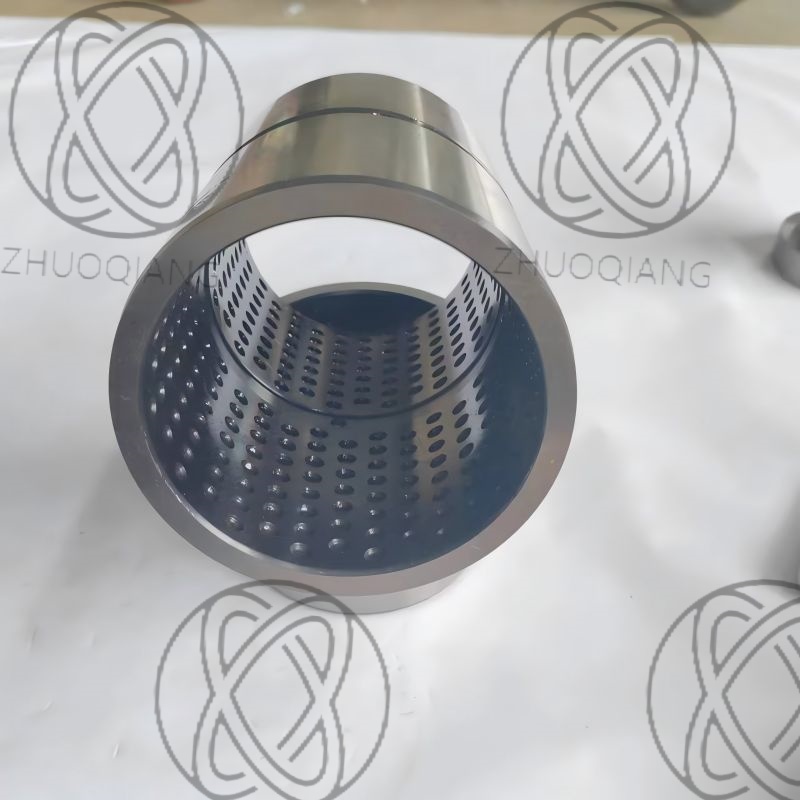
The internal grooving pattern determines how effectively the bushing distributes lubricant across the pin surface. A dry pin destroys metal rapidly.
You must specify strict ISO interference fits, such as H7/g6, depending on the specific joint requirements. Loose tolerances cause micro-movements during operation. This slight shifting leads to premature wear and wallows out the bucket bore, regardless of the material hardness. A proper interference fit requires pressing or freezing the bushing for installation, ensuring it remains totally stationary inside the bucket ear.
The internal diameter requires a highly polished surface finish. A smooth Ra value significantly reduces initial friction during the critical break-in period. Rough machining marks act like sandpaper against the pin. A polished finish prevents galling before the grease has time to fully coat the pin surfaces.
Inspect the edges of the part closely. Look for smooth, well-machined chamfers. Good chamfering allows for much easier pressing during installation. More importantly, it prevents stress risers at the edges. Sharp, unchamfered edges often initiate micro-cracks when mechanics drive the bushing into a tight bore.
Finding a reliable supplier requires asking tough technical questions. You cannot build a durable fleet relying on vague promises of quality.
Legitimate suppliers easily provide metallurgical testing certificates. They should also supply depth-of-hardness cross-section reports upon request. These documents prove the exact thickness of the hardened outer layer. If a vendor hesitates to share their hardness testing data, walk away immediately. Validating your excavator bushing hardness specifications protects your equipment investment.
Look for vendors utilizing modern CNC machining centers. CNC equipment ensures tight dimensional tolerances across large batches. Furthermore, inquire about their quenching processes. Controlled-atmosphere quenching prevents carbon depletion on the steel surface, ensuring batch-to-batch consistency and predictable wear rates in the dirt.
Engineering specs must match field behavior. If your field crews are notorious for skipping daily greasing schedules, adapt your purchasing strategy. Lean toward materials offering higher natural galling resistance. Alternatively, invest in self-lubricating composite properties. While these cost more upfront, they survive neglect far better than standard steel alloys relying on daily grease purging.
Stop ordering parts blindly. Create a standardized spec sheet for your entire fleet. Document exactly what you expect for different joints. For example, mandate: "All bucket-to-stick joints must utilize 42CrMo steel, induction hardened to 52-55 HRC, featuring Figure-8 grease grooves and a polished internal finish." Hand this exact specification to your vendors and hold them accountable upon delivery.
Sourcing the right excavator bushing requires carefully balancing material strength, precise heat treatment, and application-specific geometry. Relying on dimensions alone invites catastrophic joint failure and massive repair bills. You must evaluate the metallurgy, the internal grooving, and the hardness depth to ensure maximum longevity.
Avoid commoditizing these critical parts. Paying a 20% premium upfront for a high-quality 42CrMo bushing with proper induction hardening yields massive returns. It can easily double the lifecycle of the joint. This small initial investment saves thousands of dollars in mechanic labor, replacement pins, and unplanned machine downtime.
Take action today. Consult with your current parts supplier to review the specific metallurgical specs of your existing inventory. Demand transparency on their heat treatment processes. If they cannot provide data, request a sample component and send it out for independent, destructive hardness testing. Upgrading your specifications now will keep your buckets digging and your operating expenses low.
A: While it varies by machine size and material, a surface hardness of 48–55 HRC paired with a softer, ductile core is the industry standard for durability and impact resistance.
A: Typically, yes. It is usually more economical and practical to have the bushing act as the primary sacrificial wear part, though some OEMs match the hardness to prolong the life of both simultaneously.
A: Cracking is generally caused by one of three things: excessive through-hardness (making the metal brittle), an oversized outer diameter causing excessive interference fit stress, or extreme misalignment during the pressing process.
A: While common in hydraulic cylinders and certain linkage points, bronze is generally too soft for the high-impact, abrasive environment of a bucket digging joint unless heavily specialized (e.g., graphite-plugged manganese bronze for specific low-maintenance scenarios).