+86-17692703999
+86-17692703999 No. 6, West Side Auxiliary Road,
Sunshine Street, Linxi County, Xingtai
City, Hebei Province
Sunshine Street, Linxi County, Xingtai
City, Hebei Province

Views: 0 Author: Site Editor Publish Time: 2026-10-26 Origin: Site

Heavy earthmoving equipment faces brutal shear forces daily. A 20-ton excavator relies entirely on its pivot points. The seemingly simple pin shaft connecting major linkages often becomes the weakest link in the entire hydraulic system. Premature pin failure means more than just frustrating delays. It triggers costly downtime, secondary cylinder damage, and severe on-site safety hazards. Many catastrophic failures happen because the internal metallurgical structure was compromised on the factory floor, long before the part reached the job site.
Modern hydraulic systems now push higher breakout forces than ever before. Consequently, equipment manufacturers are shifting away from traditional machining. They demand components with optimized internal grain structures to handle these escalating dynamic loads. In this comprehensive guide, we will explore the critical concept of grain flow in metallurgy. How a component is manufactured dictates its internal structural integrity. Specifically, we will demonstrate how advanced forging processes create a durable component capable of withstanding the extreme environments of modern earthmoving applications.
Key Takeaways
To truly understand the mechanical durability of heavy equipment components, engineers must first examine the metallurgical concept of grain flow. When steel is initially cast into ingots, it forms a random dendritic crystal structure. As this steel is subsequently rolled or forged at high temperatures, the internal impurities, inclusions, and crystal structures stretch and align in a specific direction. This directional alignment is known as grain flow. Visually, it closely resembles the longitudinal grain found in a piece of wood.
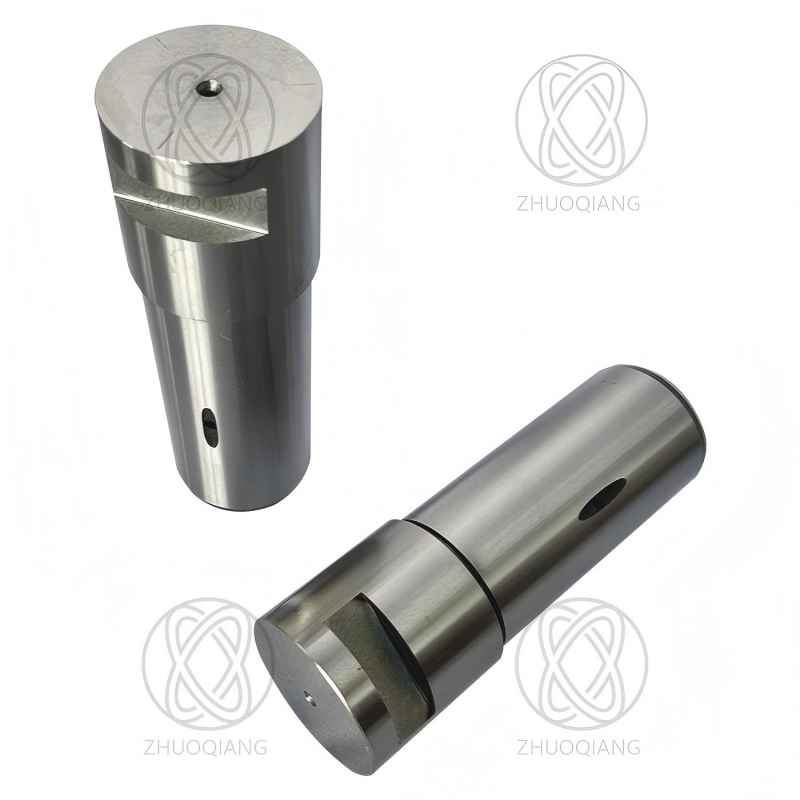
The anatomy of a heavy-duty pin typically features a cylindrical body terminating in a flanged head or incorporating specific retention grooves. The direction of the internal grain flow relative to the applied mechanical load fundamentally dictates the overall strength of this component. For maximum structural integrity, the grain lines must follow the exterior contour of the part continuously.
When evaluating a reliable construction machinery pin shaft, procurement teams prioritize this continuous alignment. If the grain flow runs parallel to the surface and bends naturally around the geometric transitions, the pin achieves anisotropic properties. Consequently, its mechanical strength is optimized in the exact directions where shear and bending stresses are most severe during operation.
Achieving an optimal internal structure requires specific manufacturing techniques. Not all metal forming methods manipulate grain flow effectively. Precision is required to keep the internal matrix unbroken.
Upset forging is a highly specialized process utilized primarily for components requiring a larger diameter head on a smaller diameter shaft. The process begins with localized induction heating of a specific section of a steel rod. Once the metal reaches its plastic deformation temperature range, immense mechanical pressure is applied to the end of the rod along its longitudinal axis. This pressure forces the heated metal to gather and expand outward into a die cavity, forming the head.
Crucially, upset forging forces the internal grain lines to fan out smoothly. They follow the exact shape of the newly formed head. This seamless transition prevents the formation of stress risers at the fillet radius, which is the critical junction where the head meets the shaft. The result is a premium part capable of withstanding extreme lateral loads without snapping.
Closed-die forging involves compressing a heated steel billet between two custom-machined dies containing the negative profile of the desired part. As the dies close under immense hydraulic pressure, the metal is forced to fill the cavity entirely.
This method compresses the internal grain structure, aligning it strictly to the exterior contours of the pin. The high pressure refines the grain size and significantly increases the structural density of the steel. Furthermore, closed-die forging is highly repeatable. It produces heavy-duty parts with exceptional dimensional accuracy and uniform mechanical properties across large production batches.
While closed-die forging is ideal for standard sizes, open-die forging is often employed for massive oversized pins used in mining excavators or heavy-lift cranes. In this process, the heated metal is hammered or pressed between flat dies that do not completely enclose the material. While it does not contour the grain flow as precisely as closed-die methods, open-die forging still effectively breaks down cast structures, closes internal voids, and refines the grain to improve the mechanical baseline of large-scale components.
The distinction between subtractive manufacturing and formative manufacturing is critical when engineering heavy-duty pivot points.
When a headed pin is manufactured strictly through CNC machining from a large cylindrical bar stock, the cutting tools remove material to reveal the final shape. This subtractive process inherently cuts directly across the natural longitudinal grain lines of the rolled steel bar. By severing these lines, the machining process exposes the ends of the grain boundaries directly at the surface of the pin.
These exposed grain ends act as microscopic stress risers. This vulnerability is particularly detrimental at the geometric transition point where the shaft diameter increases to form the head. When powerful shear forces are applied, these severed grain lines provide a path of least resistance for micro-cracks to initiate and propagate. The sharp screech of metal fatigue often precedes a sudden catastrophic failure on the job site.
In stark contrast to machining, forging bends and compresses the grain lines to match the component geometry. No grain lines are severed in the high-stress transition zones. Procurement teams sourcing heavy-duty steel pins must recognize this distinction. For heavy equipment operating under unpredictable dynamic loads, this metallurgical advantage is a strict requirement for achieving a safe lifecycle.
| Feature | CNC Machined Pin | Closed-Die / Upset Forged Pin |
|---|---|---|
| Grain Flow | Severed at geometric transitions | Continuous and contoured |
| Shear Strength | Baseline material strength | Highly optimized along the load axis |
| Fatigue Resistance | Low due to exposed grain boundaries | Exceptional |
| Impact Toughness | Prone to brittle fracture under shock | Absorbs shock loads effectively |
| Best Application | Low-stress static joints | High-stress dynamic pivot points |
The operational environment of earthmoving machinery subjects pivot points to a complex matrix of physical forces. Uninterrupted grain flow directly counteracts these forces through several distinct metallurgical mechanisms.
Excavator booms, loader arms, and dozer blades apply immense perpendicular forces directly onto the pivot pins. When the grain flow is continuous and aligned parallel to the longitudinal axis of the pin, the crystallographic planes within the steel are positioned in their strongest orientation against transverse cutting forces. Continuous grain flow drastically increases the ultimate shear strength of the metal, ensuring the pin resists deformation even under maximum payload.
Construction equipment undergoes continuous repetitive cyclic loading. Every time an excavator bucket digs into compacted soil and releases, the pins experience a brutal cycle of stress and relaxation. Over time, this cyclic loading causes metal fatigue. Microscopic cracks typically initiate at surface imperfections or severed grain boundaries. Because forged pins possess a continuous grain flow that runs parallel to the outer surface, there are far fewer exposed grain boundaries. This structural harmony significantly delays crack initiation and slows crack propagation.
Shock loads are a daily reality on job sites. When a machine bucket violently strikes solid bedrock, the sudden kinetic energy transfer is massive. The ability of a pin to absorb these sudden impacts without shattering is known as impact toughness. Steel exhibits much higher impact toughness in the longitudinal direction of its grain flow. By preserving this flow through forging, the pin retains the ductility required to absorb shock energy without undergoing brittle fracture.
Achieving an uninterrupted grain flow through forging is only the foundational step in manufacturing a reliable pivot point. To produce a truly premium component, the forged steel must undergo precise thermal processing. The mechanical synergy between a forged internal structure and advanced heat treatment is what ultimately determines the lifecycle of the part.
Forging aligns the internal grain structure to follow physical contours. However, the steel remains relatively soft immediately after the forging process. Without subsequent hardening, the pin would rapidly wear down from the constant abrasive friction generated by pivoting bushings and silica dust infiltration. Conversely, if hardened incorrectly, the metal becomes overly brittle and prone to snapping.
To solve this conflict, manufacturers utilize targeted induction hardening. An alternating high-frequency electrical current passes through a copper coil surrounding the pin, rapidly heating the surface to its austenitizing temperature. It is then immediately quenched. This localized process transforms the outer layer into a highly wear-resistant martensitic structure. High-quality pins utilize materials like 40Cr or 42CrMo. They undergo quenching and tempering to reach a core hardness of HRC 28 to 32. Subsequent induction hardening pushes the surface hardness to HRC 50 to 60, with a hardened depth of 1.5mm to 3mm. Meanwhile, the core remains relatively cool, retaining the ductile impact-absorbing properties established during forging.
The theoretical benefits of continuous grain flow and localized heat treatment translate directly to empirical performance gains in the field. Certain pivot points on heavy machinery are subjected to such extreme multi-directional forces that utilizing basic machined or cast pins is an unacceptable engineering risk.
Hydraulic excavators rely on complex linkage geometries to multiply the force of their hydraulic cylinders. The pins connecting the bucket to the I-frame act as the primary fulcrum for this violent force transfer.
When teeth bite into solid rock, the kinetic energy of the moving boom and the hydraulic pressure instantly converge on the bucket pins. If a pin was simply machined from bar stock, the severed grain lines at the radius of the pin head would provide a clear path for fatigue cracks to propagate. Utilizing precision-engineered components like a premium construction machinery pin ensures the grain flow is optimized to handle these severe breakout forces without shearing. This structural density is required to maintain tight dimensional tolerances, preventing the premature wear that destroys digging efficiency.
Wheel loaders present a distinctly different set of mechanical challenges. Highly mobile, they drive forcefully into stockpiles of dense materials like gravel or blasted rock. The lift arm pins experience severe dynamic loading as the machine rams into a pile and simultaneously engages the lift cylinders.
Furthermore, the most critical stress point on a wheel loader is the central articulation joint, which allows the chassis to pivot for steering. These articulation pins endure shear stress from the loaded front chassis, torsional stress from steering cylinders, and bending moments from uneven terrain. The compression refines internal voids and aligns the grain to handle multi-directional stress, keeping the loader chassis uncompromised.
Understanding the metallurgical advantages of grain flow is only useful if you can effectively procure components possessing these characteristics. The heavy equipment aftermarket is flooded with low-cost replacement parts that prioritize ease of manufacturing over structural integrity. To ensure maximum uptime, fleet managers must adopt a rigorous sourcing approach.
First, conduct a forensic analysis of your current failures. If pins are snapping in half, the core is either too brittle or the grain structure is severed. You need to specify upset or closed-die forged pins with a ductile core. If they are wearing down quickly, the surface hardness is insufficient, requiring a deeper induction-hardened case.
When vetting a new supplier, ask direct technical questions. Do not assume all aftermarket pins are forged. Ask if they machine their headed pins directly from bar stock or if they utilize upset forging. Request Material Test Reports to verify the chemical composition of the steel lot. Check dimensional and material specs closely. High-end pins maintain a diameter tolerance of roughly 0.02mm and a surface roughness of Ra 0.4 to 0.8.
Partnering with dedicated manufacturing facilities that possess in-house metallurgical laboratories ensures the hardware you install will meet or exceed operational demands. Sourcing custom steel pins with documented track records ultimately protects your heavy equipment investment.
The secret to a reliable construction machinery pin shaft is hidden deep beneath its polished exterior. While standard machined parts may look identical on a warehouse shelf, their internal structure dictates their true performance in the field. Upset and closed-die forging processes are absolutely essential for creating the continuous unbroken grain flow necessary to survive the brutal high-stress environments of modern earthmoving sites.
Investing the time to source premium components engineered with optimal grain flow and advanced induction hardening saves thousands of dollars in emergency maintenance and catastrophic machine downtime. Do not let a weak pivot point paralyze your fleet. Evaluate your machinery demands and upgrade to forged induction-hardened components. Explore the comprehensive catalog of precision-engineered pins at MAPARTS to find the exact fit for your heavy-duty applications.
Not with the naked eye on a finished ready-to-install pin. The exterior surface of a forged pin is typically machined and polished to achieve the required dimensional tolerances, which hides the internal structure. Grain flow can only be visually confirmed through destructive testing in a metallurgical laboratory, where the pin is cut along its longitudinal axis, polished, and treated with a chemical etchant such as Nital acid to reveal the directional flow lines.
No, a cast pin is significantly weaker. Casting involves melting steel into a liquid state and pouring it into a mold, resulting in a random dendritic crystalline structure that often contains microscopic porosity and shrinkage voids. Forging compresses solid steel under immense pressure, closing internal voids and aligning the grain structure directionally. This anisotropic nature makes forged components vastly superior in handling directional shear and bending loads.
While forging provides the optimal internal structure, a forged pin can still fail if the manufacturer selects an inappropriate steel grade for the application, such as using low-carbon steel where high-tensile alloy is required. Failures also occur if the heat treatment process is flawed, such as quenching too rapidly without proper tempering, which causes excessive brittleness. Finally, extreme operational abuse exceeding engineered safety margins will eventually cause any component to fail.
While the ideal choice depends on the specific machine size and operating environment, alloy steels like 42CrMo and 40Cr are considered the industry gold standards. These medium-carbon alloys offer an exceptional balance of properties. When properly forged to establish continuous grain flow and subsequently induction-hardened, they provide a highly wear-resistant surface while maintaining a tough ductile core capable of absorbing severe shock loads.
The depth of the induction-hardened case directly determines how long the pin can resist abrasive wear before the softer core is exposed. A standard depth is typically 1.5mm to 3mm. If the hardened layer is too shallow, the pin will wear out prematurely from friction against the bushing. If the hardened layer is too deep, the pin loses its ductile core, becoming overly brittle and highly susceptible to snapping under heavy shock loads.
Upset forging applies pressure to the end of a heated rod to gather metal and form a head, making it the superior choice for flanged or headed pins because it fans the grain lines smoothly into the head. Closed-die forging compresses a billet between two custom dies to form the entire shape of the pin simultaneously. Both methods preserve continuous grain flow, but upset forging is specifically tailored for components requiring a distinct head-to-shaft transition.